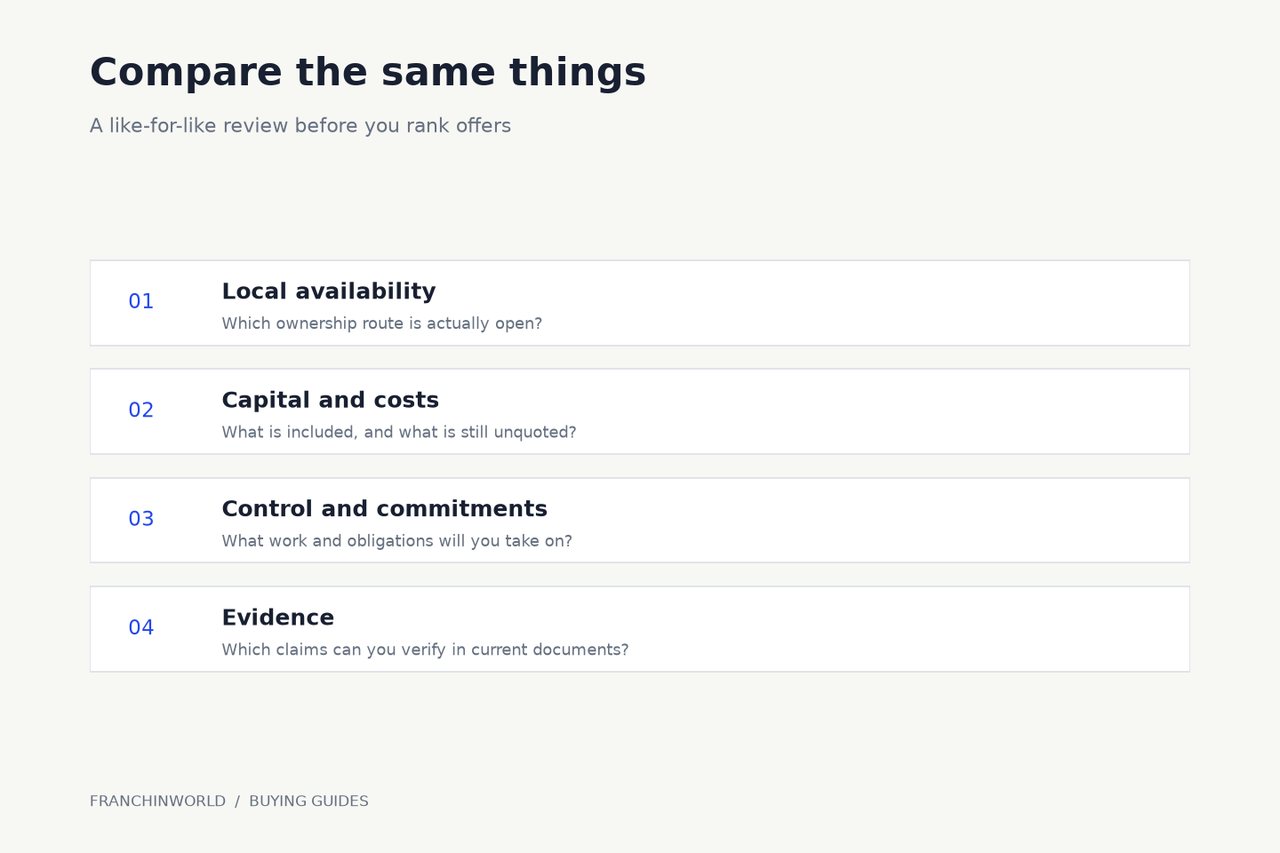
Confirm that the opportunity is available to you
Start with the actual application route. A company can operate franchised locations while working only with selected corporate partners. A brand may accept multi-unit operators but offer no current route for an individual first-time owner. Other arrangements, such as supplying branded coffee equipment, may look familiar to customers without being a shop franchise.
Record the exact model next to each brand: direct unit ownership, a development agreement, a corporate partnership or an unconfirmed public offer. Check the country as well. Ownership terms found on a US website should not be treated as the offer available in Spain or Britain.
Compare the same financial measures
Create separate columns for the initial franchise fee, full opening investment estimate, required liquid assets, required net worth and ongoing charges. Include the source and date for each figure. Leave an unknown item marked as unknown rather than filling it with a number from an unrelated territory.
Next, define the business format and property arrangement. Compare similar premises and operating commitments wherever possible. If one estimate excludes construction or working capital and another includes them, explain that difference in your worksheet before deciding that one brand is cheaper.
Examine the operating commitment
Consider the work involved as well as the money required. Ask who must manage the operation, whether relocation is expected, how long training lasts and whether you can maintain another job. Check who pays living expenses during training and whether a partner or investor is permitted under the proposed arrangement.
Evaluate territory, site approval, opening timetable, supplier requirements, refurbishment obligations and the circumstances in which you can sell or exit. Make a list of unresolved questions for each agreement. A term that looks acceptable for an experienced multi-unit operator may be difficult for a first-time owner with one location.
Test claims and keep the comparison auditable
Ask for supporting documents behind financial claims. Distinguish revenue from operating profit, owner earnings and cash remaining after debt payments. Look for differences between company-operated units and franchised units, and between an average result and the particular location you are considering.
Speak with relevant existing and former operators where appropriate, document what you learn and compare it with the written offer. The FTC’s US franchise guide provides further background on investigating an offer. Keep local requirements separate when researching other countries. A useful comparison ends with a shortlist and open questions, not a promise that a particular brand will be profitable.
Before you move forward
Frequently asked questions
Can I compare different countries directly?
First align currency, business format, ownership model, included costs and local availability. A headline fee alone is not a comparable project budget.
Does a famous brand guarantee demand?
No. Assess the proposed location and customer evidence separately.
What should remain on the shortlist?
Offers whose current local availability and obligations you can verify, with unresolved assumptions clearly recorded.
This is a general research framework, not legal, tax or financial advice. Requirements depend on your country, brand and proposed transaction.
Continue your research
Explore brand guides and follow the official sources in each guide to verify local terms.