The question this model answers
An operating break-even model asks how much sales revenue would cover the costs you include for a defined period. It is useful for testing whether your assumptions are internally consistent. It cannot establish that a particular site will attract enough customers or that a franchise investment will recover its purchase price.
Choose one period and use it consistently. This worksheet uses a month. Enter a monthly rent figure rather than an annual one, and choose trading days that match your staffing and opening plan. Keep a note of where every input came from so the model can be updated as quotes replace estimates.
Classify costs before entering them
Fixed costs in this model are the costs you treat as independent of sales over the period being tested. Variable costs are entered as a percentage of sales. Food ingredients, transaction charges and sales-based royalties may belong in that percentage, depending on the business and your accounting definitions.
Staffing is often less tidy. A minimum team may be needed even on a quiet day, while extra shifts are added at higher volumes. You can run several scenarios with different fixed staffing assumptions. The simple calculator does not model every staffing step or capacity constraint.
How the calculation works
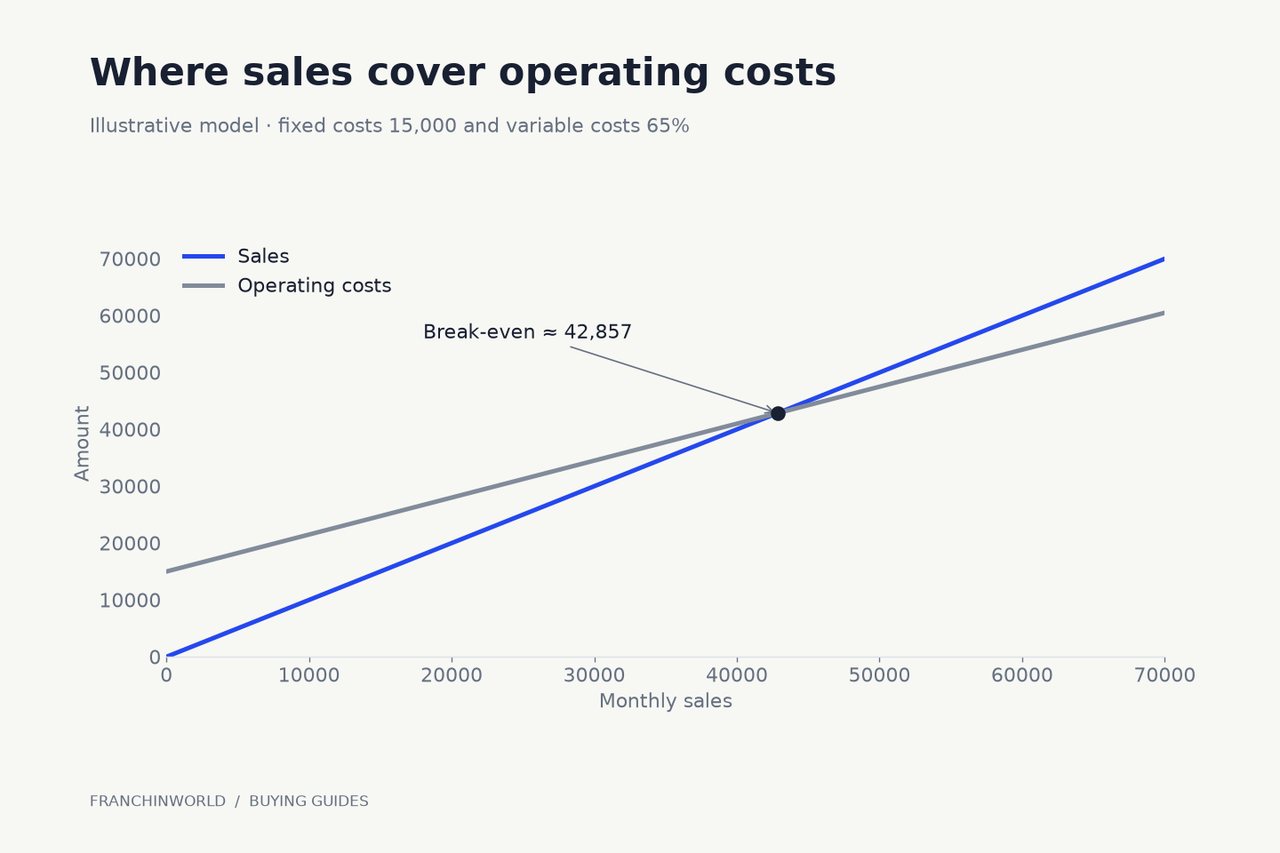
The contribution margin is the share of sales left after the variable costs you enter. If the variable share is 65%, the contribution margin is 35%. With monthly fixed costs of 15,000, the arithmetic break-even sales level is about 42,857. These are example inputs rather than a restaurant forecast.
The calculator divides that revenue by your average transaction value and trading days to show an approximate daily transaction requirement. It rounds up that number. A single average ticket can conceal differences between delivery, takeaway and dine-in orders, so use a weighted assumption that matches your planned sales mix.
Check the result against the operation
Convert the daily total into a practical service question. Could the proposed team, kitchen and seating process that many transactions during the hours customers actually visit? A daily average that looks reasonable can still require an implausible peak-hour throughput.
Then test whether customer demand supports it. Count the evidence behind your traffic, conversion and repeat-visit assumptions. Ask what would change if average transaction value falls or discounts become necessary. Increasing sales in a spreadsheet is easy; an operating plan needs a credible route to those sales.
Break-even is different from investment payback
A business can cover a selected set of monthly costs without recovering the money invested in opening it. Debt service, taxes, owner remuneration, replacement equipment and future refurbishment need explicit treatment. If they are omitted from the input costs, they are omitted from the result.
Keep a separate cash-flow forecast for opening delays, seasonality and payment timing. Compare optimistic, base and downside scenarios and identify the funding required in each. If the variable-cost share reaches 100%, the model correctly refuses a finite break-even result because no contribution remains to cover fixed costs.
Method reference
The formula is consistent with the US Small Business Administration break-even explanation: fixed costs divided by the contribution per unit, or the equivalent contribution margin for sales revenue. This worksheet is a simplified editorial planning tool.
How much do you need to sell?
Frequently asked questions
Is operating break-even the same as payback?
No. Covering the costs entered for one month does not recover the initial investment.
Why is there no result at 100% variable costs?
No contribution remains to cover fixed costs, so this model cannot produce a finite break-even sales level.
Does the result prove customer demand?
No. It shows the sales required by your assumptions, not the sales a location will achieve.
This is a general research framework, not legal, tax or financial advice. Requirements depend on your country, brand and proposed transaction.
Continue your research
Explore brand guides and follow the official sources in each guide to verify local terms.