What an FDD can help you investigate
A US Franchise Disclosure Document is a structured starting point for investigating a franchise. It brings important information into one document, but receiving it does not mean that the government has recommended the business. Read it alongside the agreement, proposed lease, funding terms and the actual transaction you are considering.
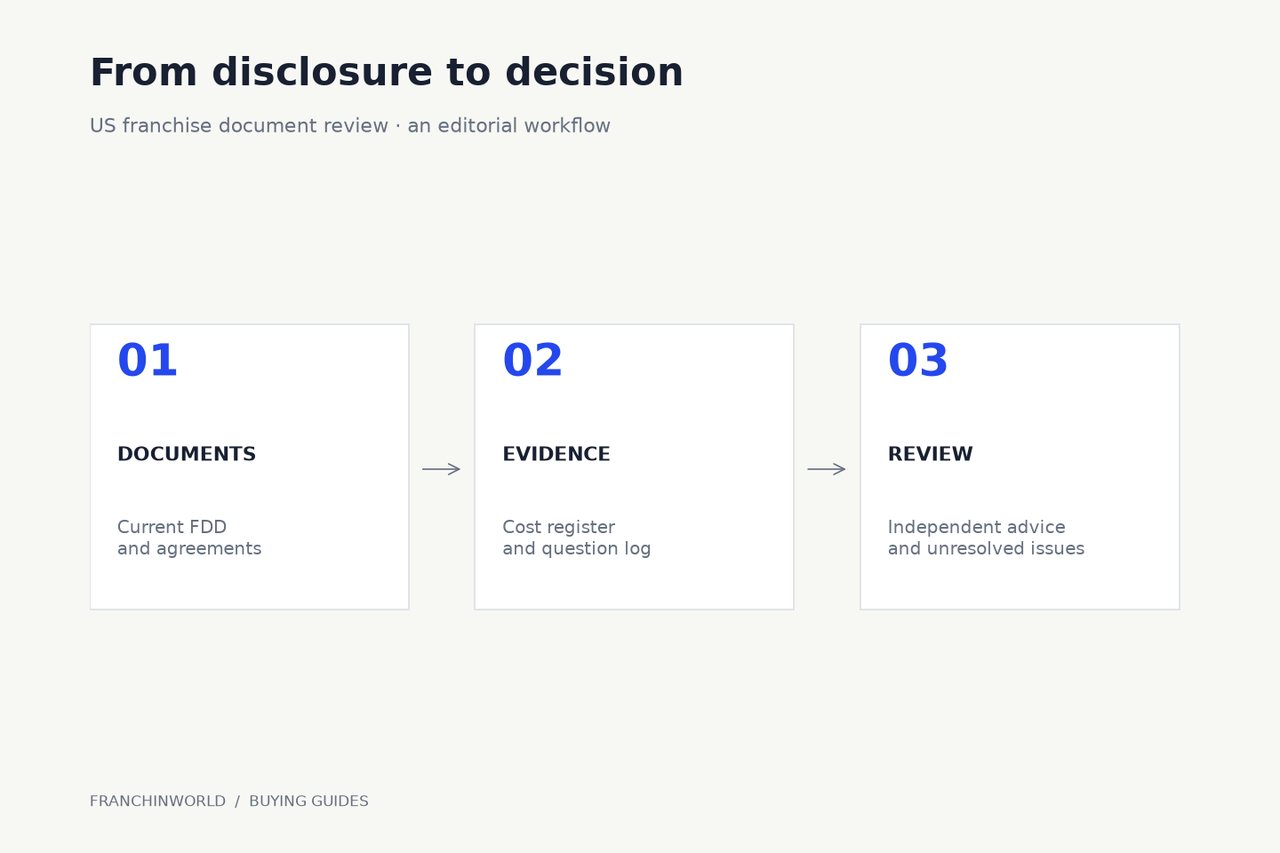
Use two separate files during your review: an evidence folder containing the documents and a question log recording what is unclear. For each answer, note who supplied it, when it was supplied and where it appears in the documents. A verbal reassurance should not quietly become a fact in your budget.
Start with the offer you are actually buying
A new unit, an existing business and a multi-unit development proposal need different checks. Identify the legal seller, the proposed owner of the franchise rights, the operating location and the assets included. Check whether the document and its amendments cover that exact offer and market.
Under the US FTC Franchise Rule, prospective franchisees must receive the FDD at least 14 days before signing a contract or paying the franchisor or its affiliate. Use that minimum period to organise a proper review; it is not a target deadline for finishing due diligence. Local legal advice can identify additional requirements.
Connect fees, restrictions and operating assumptions
Make a cost register instead of copying one headline investment figure. For every charge, record its trigger, calculation base, payment date, whether it changes and where it appears in the agreement. Separate opening costs from recurring charges and potential refurbishment commitments.
Next compare those commitments with your operating plan. If suppliers, systems or opening hours are prescribed, ask how that affects your quotes and staffing assumptions. If a development schedule covers several units, model the timing of all commitments rather than treating the first opening as the entire project.
Treat performance evidence as a separate investigation
Item 19 is the place to check any financial performance representations the franchisor chooses to provide. An impressive sales figure still needs context: the location format, reporting period, sample selection and costs underneath it. Revenue alone does not establish owner income.
Keep your own sales scenario clearly labelled as an assumption. Ask an accountant to reconcile the cost categories in the disclosed information with your proposed budget. Document omissions and differences rather than filling them with a directory estimate from another country.
Build a decision record before signing
Give your adviser the full document set, not just the pages you think are problematic. Ask for a written list of obligations that continue through renewal, sale, termination or a change of ownership. Review personal commitments and the proposed property arrangement together.
Use the checklist below as a progress tracker. Marking every task complete is not an approval score. If a material question remains unresolved, record its consequence for the project and decide what evidence would resolve it. A slower decision based on a complete file is more useful than a fast comparison built on incompatible figures.
Official reference
This guide uses the FTC consumer guide to buying a franchise for US disclosure context. Checked 5 November 2026. It does not apply US disclosure rules to UK or Spanish transactions.
Before you move forward
Frequently asked questions
Does an FDD mean the business is approved?
No. Disclosure is a source for investigation, not an endorsement or a guarantee of results.
Which country does this FDD guide concern?
The US. Do not assume the same disclosure process applies in the UK, Spain or another country.
Can the checklist replace a legal review?
No. Have independent advisers review the current documents and the specific proposed transaction.
This is a general research framework, not legal, tax or financial advice. Requirements depend on your country, brand and proposed transaction.
Continue your research
Explore brand guides and follow the official sources in each guide to verify local terms.