Working capital and cash runway answer different questions
In accounting, working capital generally means current assets less current liabilities. That is not the same as the cash available in a bank account. Inventory and receivables may be current assets, but you cannot always use them immediately to meet payroll. For opening a franchise, keep the balance-sheet calculation and the cash funding plan separate.
The cash-runway worksheet on this page asks a narrower question: how long would an available cash reserve last if the monthly receipts and payments entered stayed constant? It is a simple scenario, not a working-capital valuation or a forecast of trading.
Start after the opening payments
Work out what unrestricted cash remains once the payments already committed to opening have been funded. Do not count a construction deposit as both money spent and money still available for operating the business. Separate personal living funds from company cash and identify any restrictions on borrowing.
List the payment dates for rent, staffing, suppliers, insurance and other known commitments. Include sales-based franchise charges in the month they are payable. Add debt payments and tax payments to the cash schedule where applicable, with professional help for the actual amounts and timing.
A worked reserve example
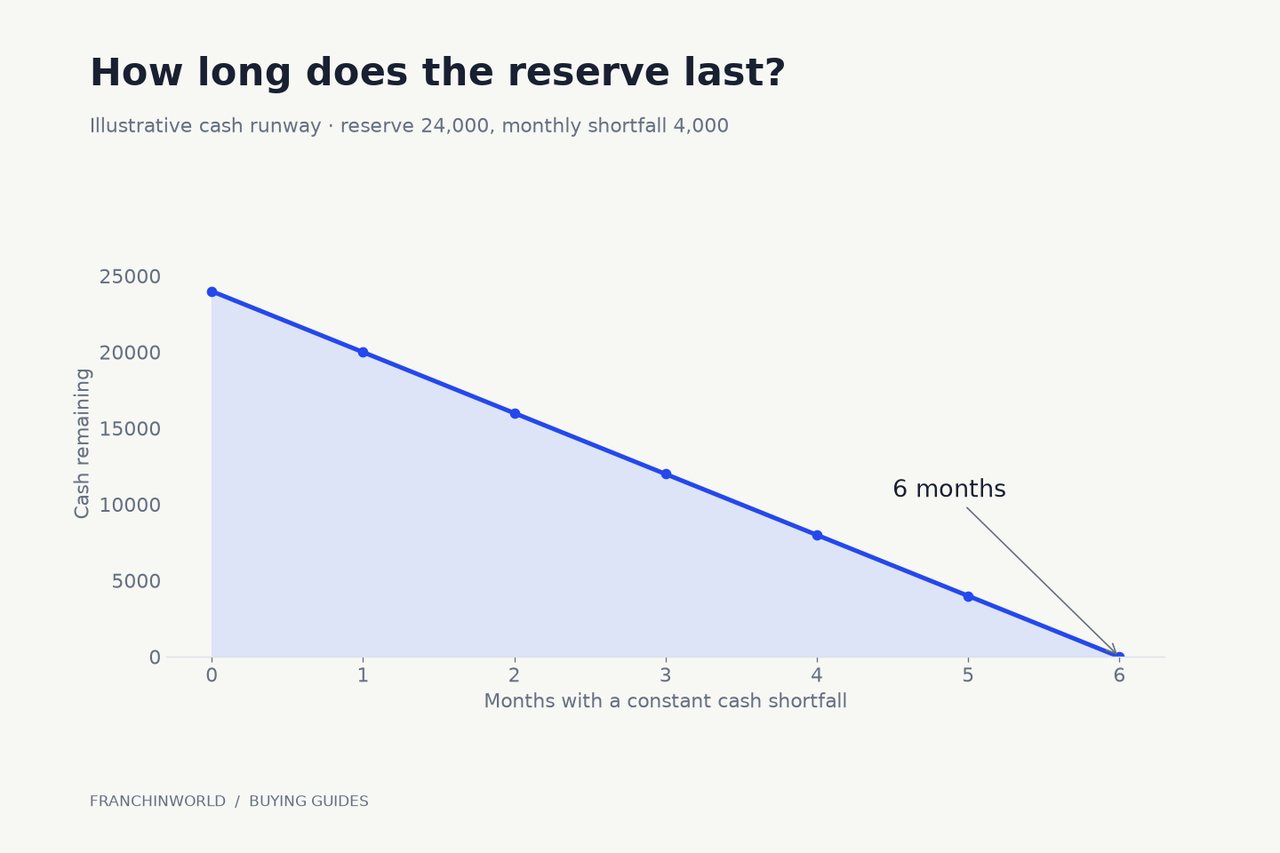
Suppose a fictional operator has 24,000 of available cash, expects monthly cash receipts of 18,000 and monthly cash payments of 22,000. The monthly shortfall is 4,000. Dividing 24,000 by 4,000 gives six months in this constant-input model. The figures describe no particular franchise.
If receipts rise to equal payments, the model reports that the reserve is not depleting under those inputs. That does not mean risk has disappeared: a one-off equipment bill, seasonal dip or delayed receipt can still change the balance. Recalculate when any of those assumptions changes.
Use a calendar for the real funding decision
A monthly average can hide the date on which cash runs out. A business can receive enough money over a month and still miss an early payroll payment. Build a week-by-week schedule around opening, then reconcile it with your monthly operating forecast.
For each period, start with the opening cash balance, add receipts and subtract payments to obtain closing cash. Carry that balance into the next period. Identify the lowest balance in a downside scenario and discuss an appropriate buffer with your advisers. There is no universal reserve amount that fits every franchise.
Connect the reserve to the rest of your research
The opening budget explains what must be funded before and around launch. The operating break-even model tests the sales needed to cover the costs you enter. Cash runway adds the timing and reserve question. None should be substituted for the others.
When comparing brands, ask what operating reserve is included in the quoted investment and what assumptions underpin it. Keep an explicitly labelled downside case for slower sales, delayed opening and a larger supplier bill. An undrawn loan or a proposed facility should not be treated as cash already received.
Sources and scope
The SBA financial glossary supplies the accounting context. The SBA finance guidance discusses bookkeeping and cash versus accrual timing. The scenario, worksheet and practical review steps here are FranchinWorld editorial analysis, checked 5 November 2026.
How long will your cash last?
Frequently asked questions
Is working capital the same as cash in the bank?
No. Accounting working capital includes current assets and current liabilities; cash runway is a separate funding scenario.
How does the runway worksheet calculate months?
It divides available cash by monthly payments minus monthly receipts when there is a positive shortfall.
What happens if monthly receipts cover payments?
The worksheet reports that cash is not depleting under those constant inputs. One-off bills, timing changes and seasonality can still create a funding need.
This is a general research framework, not legal, tax or financial advice. Requirements depend on your country, brand and proposed transaction.
Continue your research
Explore brand guides and follow the official sources in each guide to verify local terms.