A service business has a time constraint before it has a revenue forecast. Calculate the appointments you can actually deliver after allowing for preparation, travel, cleaning and administrative work.
Define the complete service slot
Count all time attached to a booking, including work before and after the customer appointment. For mobile services, include travel and route gaps. Do not divide a working day by treatment time alone if the omitted tasks still need to be done.
Separate capacity from demand
Available appointments show supply, not how many customers will book. Model utilisation using evidence and clearly labelled assumptions. Review whether demand arrives at times the business can serve, rather than assuming an evenly distributed weekly schedule.
Track cancellations and payment
Distinguish booked, attended, delivered and paid appointments. Have relevant customer policies reviewed for the market and service. Use a realistic cancellation scenario without assuming that every missed appointment can be charged or immediately resold.
A worked research example
Illustrative example: an eight-hour day contains 480 minutes. If a complete slot takes 75 minutes, six full slots fit before other constraints. At an assumed 70% utilisation across ten such days, expected usage is 42 slots, not 60 guaranteed sales.
Evidence to gather
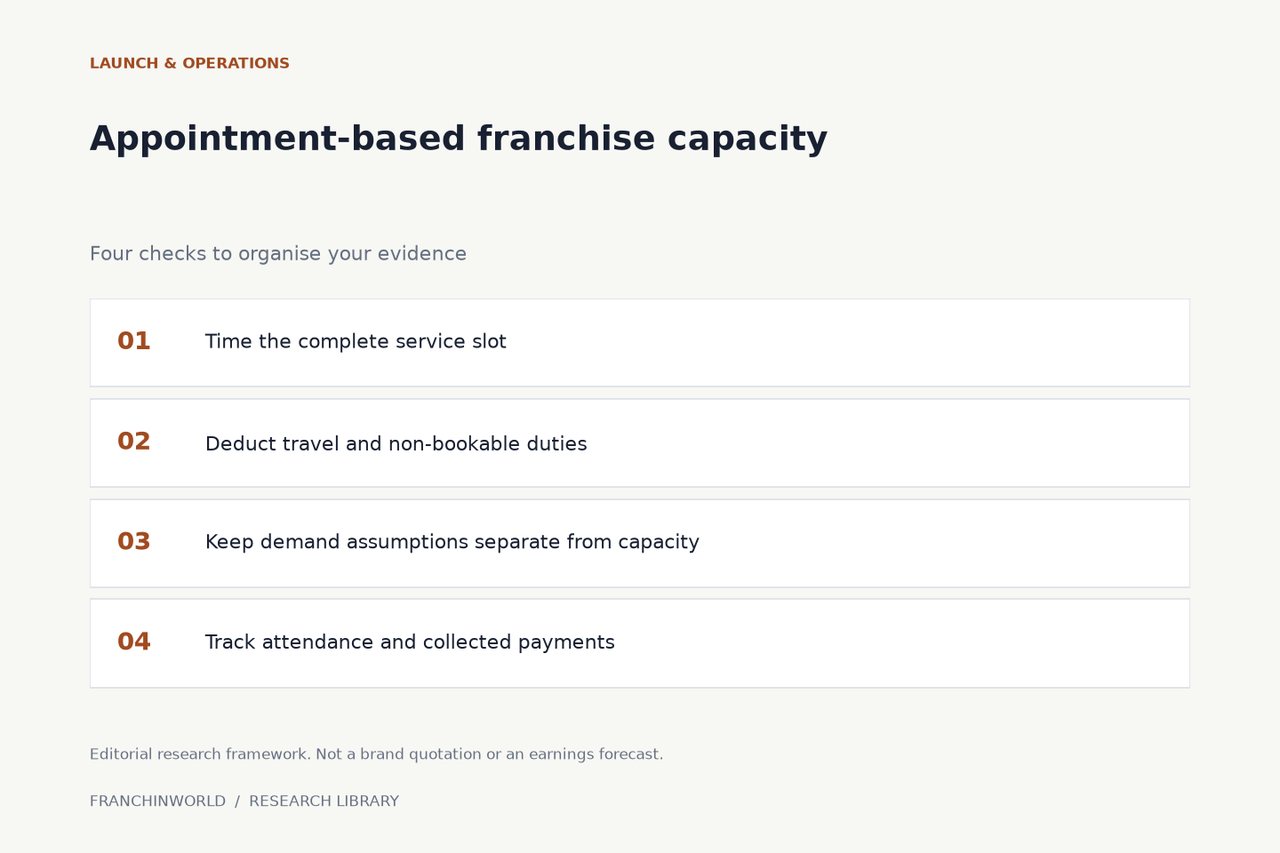
- Time the complete service slot
- Deduct travel and non-bookable duties
- Keep demand assumptions separate from capacity
- Track attendance and collected payments
Before you move forward
Frequently asked questions
Is maximum capacity a sales forecast?
No. Demand, scheduling and cancellations determine how much is used.
Should travel be included for mobile work?
Yes. It consumes time that may otherwise appear bookable.
Does a booking always count as revenue?
Use the appropriate accounting treatment and distinguish it from actual attendance and cash receipt.
Sources and scope
References checked 6 November 2026. The questions, examples and diagrams are our editorial research tools; they are not statements that every franchise has the same terms.
- SBA — Manage your business
General operating and finance background; local and contractual requirements still need checking.
- SBA — Plan your business
General US business-planning reference, not franchise-specific costs or a forecast.
General editorial information, not personalised legal, tax or financial advice. Confirm local requirements and the actual documents with appropriate advisers. Examples are hypothetical. Contact the editor or suggest a correction.
Continue your research