Franchise revenue is not owner income
Revenue records sales under the accounting rules used for the business. It does not tell you how much the owner can withdraw. Food or other direct costs, staffing, property costs, franchise charges and other operating expenses may all sit underneath that sales figure.
Keep three questions separate: what the business sells, what profit the accounts show and what cash remains available after payments and obligations. A profitable period can coincide with a cash squeeze, and receiving cash from a loan does not turn it into trading profit.
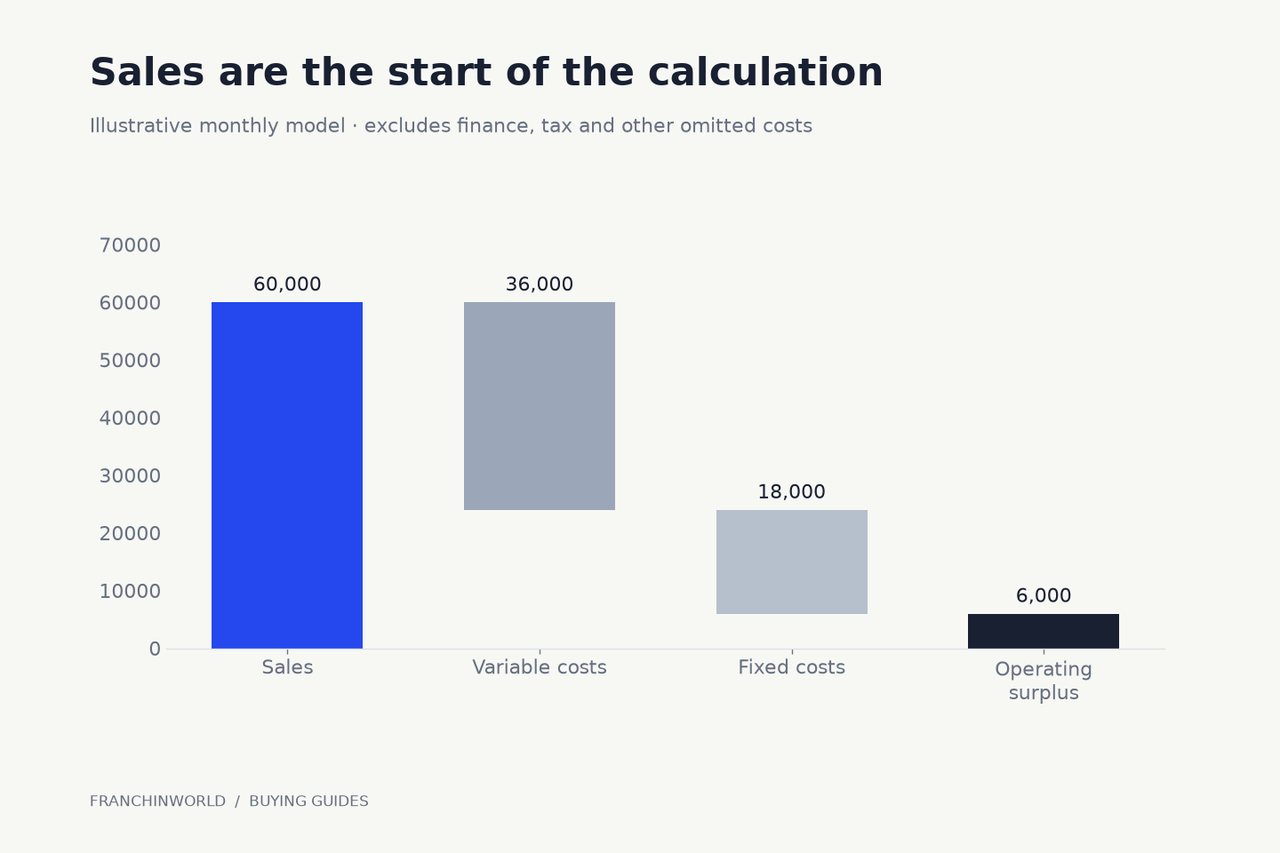
An illustrative sales-to-profit bridge
Imagine a fictional monthly model with sales of 60,000, variable operating costs of 36,000 and fixed operating costs of 18,000. The remaining 6,000 is the operating surplus under those selected assumptions. It is not a forecast for a named brand or a statement of the owner’s take-home pay.
Now ask what the costs included. If the owner worked full-time without remuneration, the surplus includes unpaid labour. If tax, finance costs or replacement equipment are omitted, they still need separate consideration. Define the accounting measure before comparing a number with another business.
Why cash can tell a different story
Credit sales, inventory purchases and supplier payment dates can cause cash movement to differ from reported profit. Buying equipment or repaying loan principal also affects cash in a way that is different from simply treating every payment as an operating expense.
For example, the fictional business might make an 8,000 equipment payment during a month with a 6,000 operating surplus. That comparison alone does not produce a complete cash-flow statement, but it shows why the surplus cannot automatically be withdrawn. Ask an accountant to reconcile actual profit, financing and cash movement.
Questions to ask about published franchise performance
Identify whether a claim concerns sales, gross margin, an operating measure or owner remuneration. Ask which units and period it covers, whether it is an average or another statistic and which costs are excluded. A figure from a mature location may not describe a new opening with a different rent and management structure.
For US opportunities, investigate any financial performance representations in the applicable disclosure documents; our FDD guide explains that review. Do not manufacture an earnings forecast from a franchise fee or financial qualification threshold.
Build a model you can reconcile
Use the same time period, sales definition and cost categories throughout your comparison. Separate sales-based charges from fixed charges and document where owner work, finance and tax are treated. Then reconcile the operating model to a payment calendar.
The break-even calculator tests the sales required to cover the entered operating costs. Our cash-runway guide looks at the reserve that funds a cash shortfall. Neither calculates a guaranteed wage, distributable profit or return on investment.
Sources and limitations
The SBA bookkeeping guidance explains why cash and accrual timing differ. For US franchise performance claims, consult the FTC buying guide. Numerical examples here are invented teaching scenarios, with the inclusions and omissions stated explicitly; they are not reported brand results.
Before you move forward
Frequently asked questions
Can I treat franchise sales as my income?
No. Sales are not owner remuneration; operating costs and other commitments must be considered.
Can a profitable business run short of cash?
Yes. Collection and payment timing, equipment spending and financing can affect cash differently from reported profit.
Are the worked examples real franchise results?
No. They are explicitly fictional arithmetic examples and provide no brand earnings forecast.
This is a general research framework, not legal, tax or financial advice. Requirements depend on your country, brand and proposed transaction.
Continue your research
Explore brand guides and follow the official sources in each guide to verify local terms.