A percentage of sales can hide how many staff hours the operation actually needs. Start with tasks and trading periods, then reconcile the resulting staffing plan with local pay and employment requirements.
Build the service coverage
Map opening preparation, customer service, breaks, cleaning, administration and closing. Separate roles that can be combined from work that must happen simultaneously. Include the owner’s contribution explicitly rather than treating unpaid owner time as unlimited capacity.
Cost the hours actually required
Use verified local rates and applicable employment costs for the proposed roles. Include preparation and closing time outside public opening hours. Ask a payroll or employment adviser about the relevant local obligations instead of applying a universal loading percentage.
Test absences and demand peaks
Plan cover for illness, training and busy periods. Check whether reducing staffing in a weak-sales scenario would impair the service needed to retain customers. A cost saving that makes the operating plan unworkable is not a credible sensitivity case.
A worked research example
Illustrative example: three people covering eight hours require 24 staff-hours, before additional preparation or closing work. At an assumed 15 per hour, that is 360 before other employment costs. The assumed rate is not a wage recommendation.
Evidence to gather
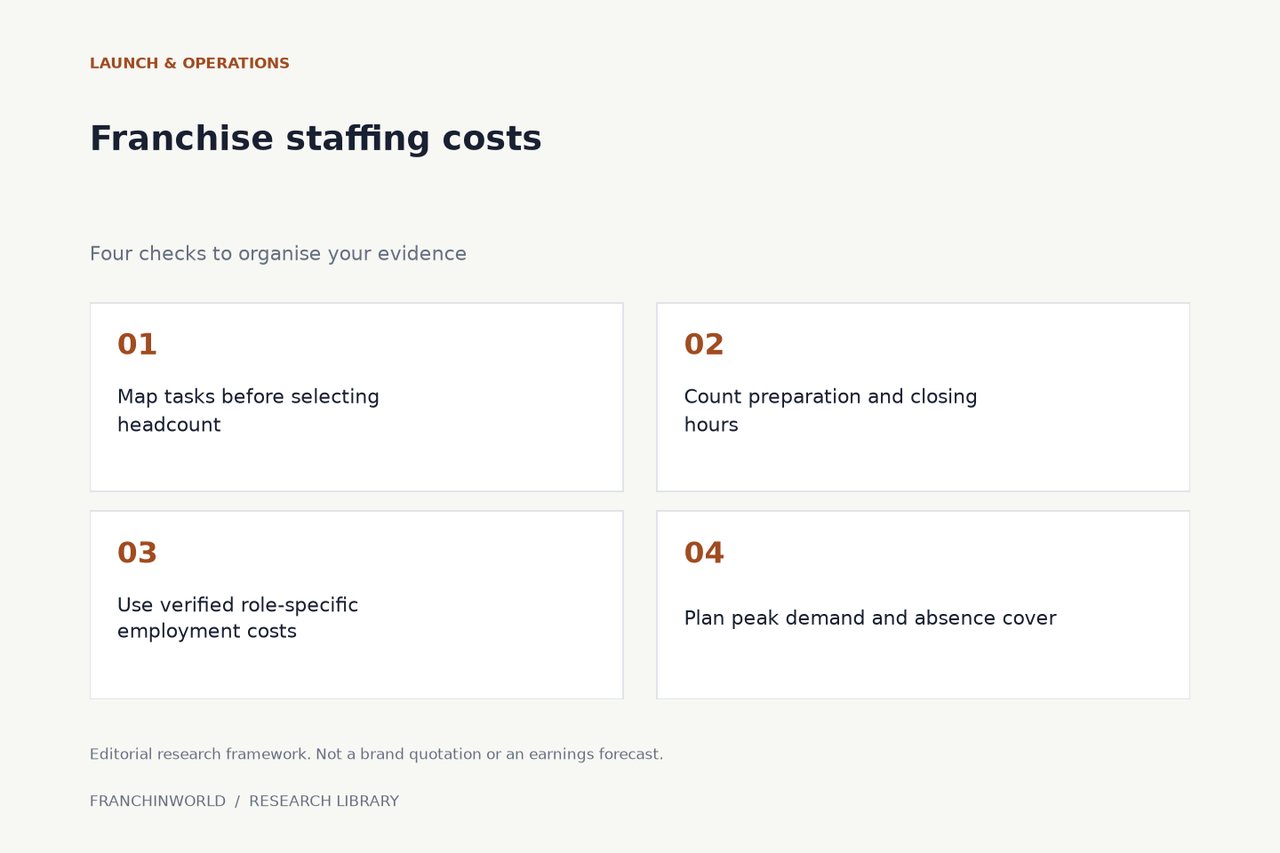
- Map tasks before selecting headcount
- Count preparation and closing hours
- Use verified role-specific employment costs
- Plan peak demand and absence cover
Before you move forward
Frequently asked questions
Does headcount equal full-time equivalents?
No. Calculate hours and employment arrangements rather than counting names.
Should owner hours be included?
Yes. Show their operational contribution and consider replacement cover.
Can I use one national staffing percentage?
Use it only as a comparison hypothesis; build the actual shift and local cost model.
Sources and scope
References checked 6 November 2026. The questions, examples and diagrams are our editorial research tools; they are not statements that every franchise has the same terms.
- SBA — Manage your business
General operating and finance background; local and contractual requirements still need checking.
- SBA — Plan your business
General US business-planning reference, not franchise-specific costs or a forecast.
General editorial information, not personalised legal, tax or financial advice. Confirm local requirements and the actual documents with appropriate advisers. Examples are hypothetical. Contact the editor or suggest a correction.
Continue your research