More delivery sales do not automatically mean more cash contribution. Build an order-level model that identifies which costs vary with the channel and which operating constraints remain shared with the shop.
Start with the actual settlement
Reconcile the menu price, discounts, refunds, platform deductions and money received. Obtain the current platform and franchise terms. Do not assume every percentage is calculated on the same base or that tax treatment is identical across markets.
Add channel-specific variable costs
Include ingredients, packaging and other verified incremental costs. Check how sales-based franchise charges apply to the relevant order. Keep fixed premises and staffing costs separate initially, then assess whether extra orders require additional capacity or labour.
Test the peak-period constraint
Delivery orders can consume kitchen capacity at the same time as higher-contribution in-store orders. Compare the order mix and waiting times, not only the average margin. A channel may contribute positively per order while making the combined peak-period plan less workable.
A worked research example
Illustrative example: an order produces 25 of revenue before an assumed 6 platform deduction, 8 ingredient cost and 1 packaging cost. It leaves 10 before other charges, labour and fixed costs. This is not a typical industry margin.
Evidence to gather
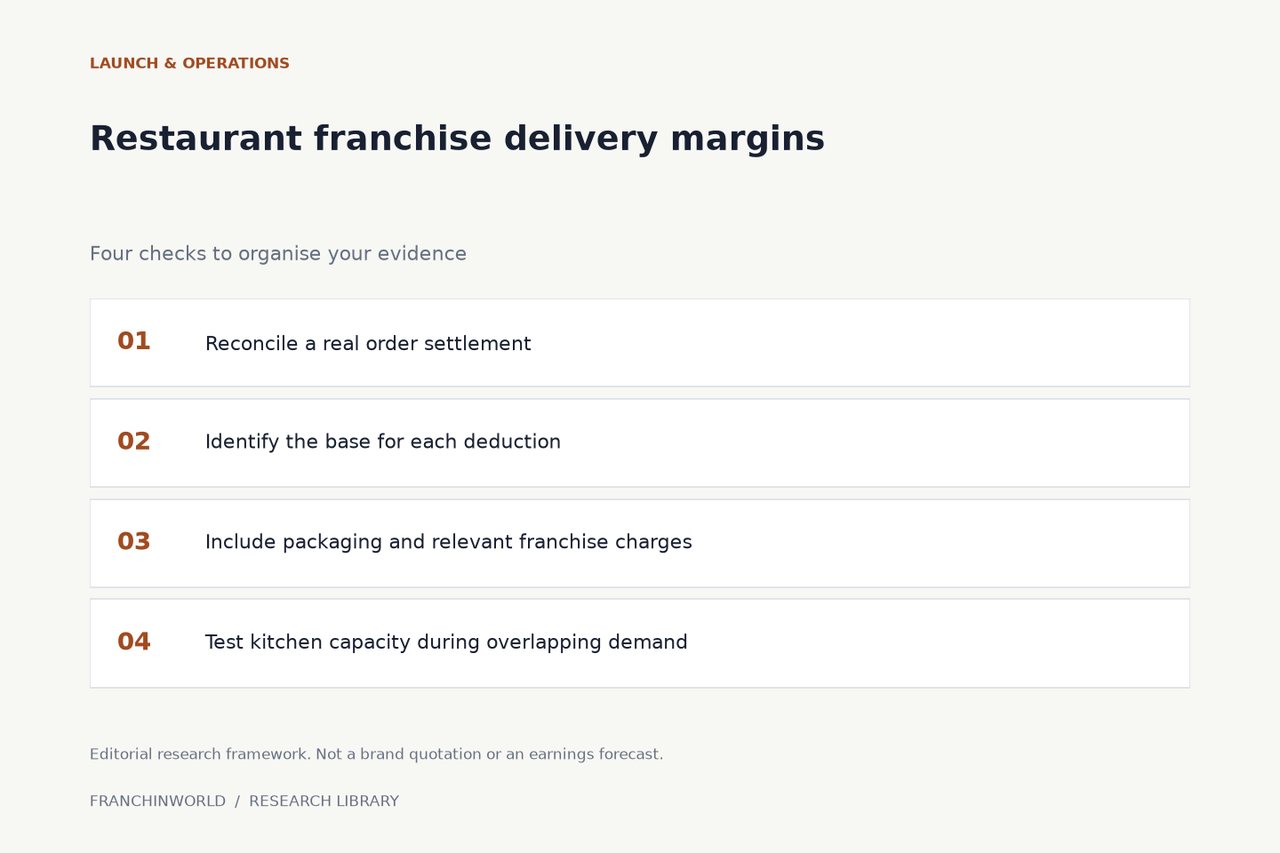
- Reconcile a real order settlement
- Identify the base for each deduction
- Include packaging and relevant franchise charges
- Test kitchen capacity during overlapping demand
The worksheet below uses editable example inputs. It does not automatically reproduce the scenario or every calculation rule discussed above.
How much do you need to sell?
Frequently asked questions
Is the platform commission the only delivery cost?
No. Packaging, discounts, refunds and operational effects may also matter.
Does positive order contribution mean profit?
Not necessarily. Fixed and other omitted costs still require coverage.
Should I assume delivery sales are all additional?
No. Investigate whether some replace existing orders or displace capacity at busy times.
Sources and scope
References checked 6 November 2026. The questions, examples and diagrams are our editorial research tools; they are not statements that every franchise has the same terms.
- SBA — Manage your business
General operating and finance background; local and contractual requirements still need checking.
- SBA — Plan your business
General US business-planning reference, not franchise-specific costs or a forecast.
General editorial information, not personalised legal, tax or financial advice. Confirm local requirements and the actual documents with appropriate advisers. Examples are hypothetical. Contact the editor or suggest a correction.
Continue your research