Annual profit can hide several consecutive months of cash pressure. A seasonal franchise needs a monthly view of receipts and payments, especially where rent, staffing or debt payments continue when demand falls.
Separate sales timing from receipts
Build a calendar that reflects when customers pay and when money reaches the account. Advance bookings, invoiced customers and card settlements can create different patterns. Use evidence from relevant trading periods rather than distributing an annual forecast evenly across twelve months.
Map the costs that continue
Identify commitments that do not fall in line with sales. Include scheduled equipment work, annual subscriptions and any seasonal stock purchases. Keep tax and financing payment dates visible without assuming their treatment is identical across countries.
Find the lowest cash balance
Start with opening cash and calculate each month’s closing position. The lowest balance helps identify the timing of a funding gap. A constant monthly runway model is useful for a rough scenario, but it cannot replace a month-by-month seasonal schedule.
A worked research example
Illustrative example: opening cash of 20,000 followed by three monthly net outflows of 4,000 leaves 8,000 before the busy season. Later profits do not fund payments already due unless a verified funding arrangement bridges the gap.
Evidence to gather
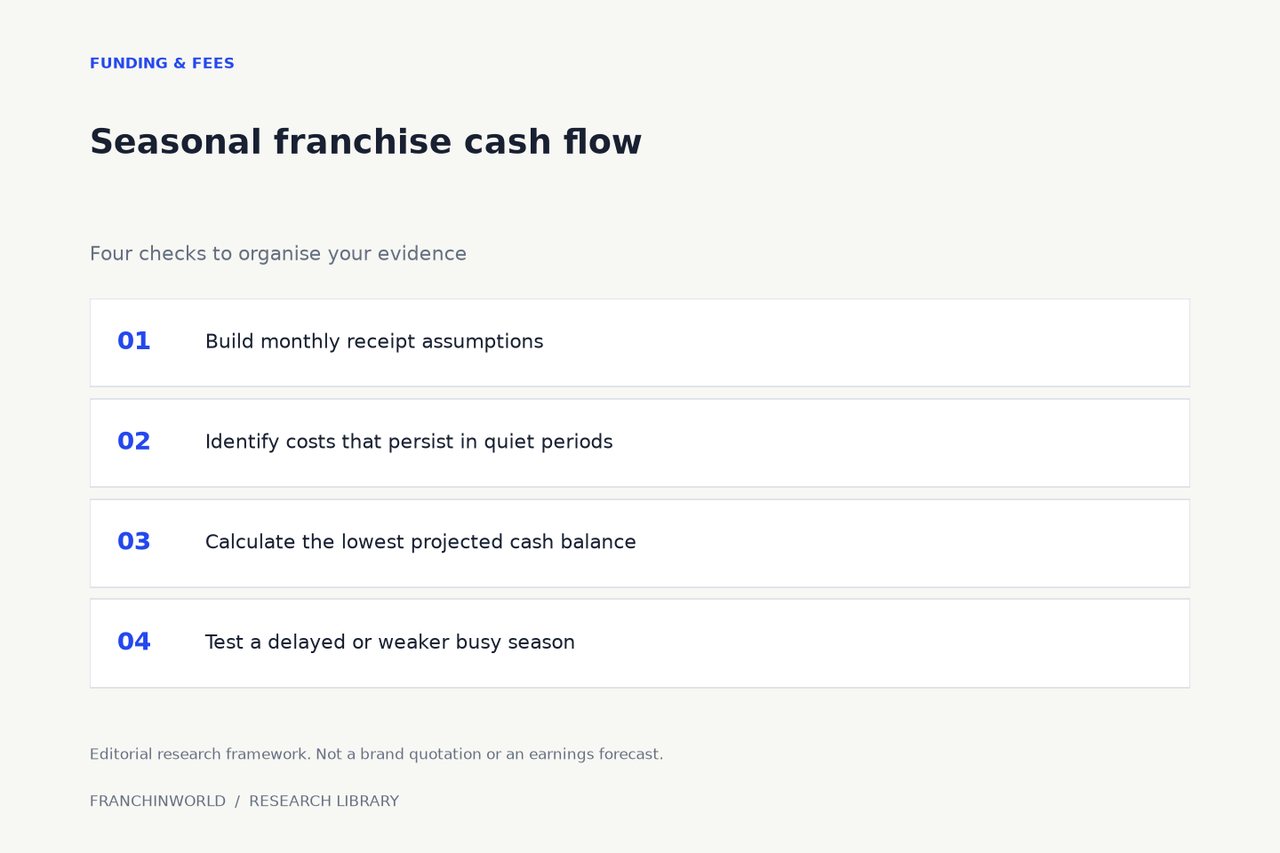
- Build monthly receipt assumptions
- Identify costs that persist in quiet periods
- Calculate the lowest projected cash balance
- Test a delayed or weaker busy season
The worksheet below uses editable example inputs. It does not automatically reproduce the scenario or every calculation rule discussed above.
How long will your cash last?
Frequently asked questions
Does annual profit prove sufficient cash?
No. The timing of receipts and payments can still create a temporary shortfall.
Can I use the same seasonality as another town?
Only as a hypothesis. Check local customer behaviour and the actual operating format.
Does the runway calculator model seasons?
No. It assumes constant monthly flows; use a separate schedule for seasonal variation.
Sources and scope
References checked 6 November 2026. The questions, examples and diagrams are our editorial research tools; they are not statements that every franchise has the same terms.
- SBA — Manage your business
General operating and finance background; local and contractual requirements still need checking.
- SBA — Plan your business
General US business-planning reference, not franchise-specific costs or a forecast.
General editorial information, not personalised legal, tax or financial advice. Confirm local requirements and the actual documents with appropriate advisers. Examples are hypothetical. Contact the editor or suggest a correction.
Continue your research